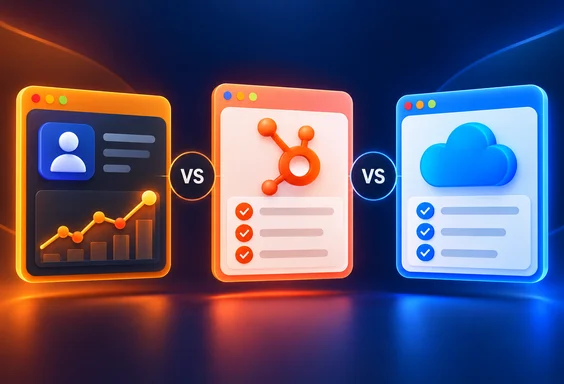
Choosing a CRM is an important decision for a growing business. Your CRM becomes the place where sales teams manage leads, customer information, opportunities, follow-ups and communication.
Businesses generally have three options: build a custom CRM, use HubSpot or use Salesforce. Each approach has different advantages depending on your requirements.
What Is a Custom CRM?
A custom CRM is software developed specifically around your business processes.
You decide:
- What information is stored
- How leads move through the pipeline
- Which dashboards exist
- How users interact with the system
- Which tools it integrates with
This provides a high level of customization.
What Is HubSpot?
HubSpot provides CRM and business tools covering areas such as sales, marketing, customer service and automation. It can be useful for businesses that want an established platform without building the core CRM themselves.
What Is Salesforce?
Salesforce is a large CRM platform designed for organizations with complex sales and customer-management requirements. It offers extensive customization, automation, integrations and enterprise capabilities.
Comparing the Options
| Requirement | Custom CRM | HubSpot | Salesforce |
|---|---|---|---|
| Customization | Very high | High | Very high |
| Initial setup | Longer | Faster | Moderate |
| Unique workflows | Excellent | Depends on configuration | Strong |
| Integrations | Built as required | Extensive ecosystem | Extensive ecosystem |
| Upfront development | Higher | Subscription | Subscription |
| Control | High | Vendor dependent | Vendor dependent |
| Scalability | Designed for requirements | Scalable | Enterprise-focused |
When Should You Consider a Custom CRM?
A custom CRM may be appropriate when your sales process is significantly different from standard CRM workflows.
For example, your company may need:
- Custom lead scoring
- Unique approval workflows
- Industry-specific fields
- Custom dashboards
- Proprietary calculations
- Deep ERP integration
- Custom AI automation
Building a CRM can also make sense when the CRM itself is part of your business product.
When Should You Consider HubSpot?
HubSpot can be useful when you want to get started quickly with an established CRM ecosystem. It can be suitable for businesses that need standard sales and marketing workflows without developing a CRM from scratch.
When Should You Consider Salesforce?
Salesforce can be considered when your organization requires a highly configurable CRM environment with complex workflows, integrations and enterprise requirements. It can be particularly relevant for larger sales organizations.
What About Cost?
A custom CRM requires an upfront development investment. HubSpot and Salesforce generally use subscription-based pricing, with costs depending on the products, users and features selected.
The important point is to compare total cost of ownership, not simply the initial price. For custom software, consider development, hosting, maintenance and future improvements. For SaaS CRM platforms, consider subscriptions, implementation, integrations and additional services.
A Better Way to Choose
Ask your team:
- How complex is our sales process?
- Which CRM features do we actually need?
- Which systems must integrate with the CRM?
- How many users will use it?
- How much customization do we need?
- How quickly do we need to deploy?
- What will the system cost over several years?
These answers will make the decision much clearer.
Final Thoughts
There is no single CRM that fits every business. HubSpot and Salesforce provide established CRM ecosystems, while a custom CRM gives businesses greater control over workflows and functionality.
The right choice depends on your business model, processes, budget and long-term requirements. At KKEYDOS, we build custom CRM platforms designed around specific sales processes, integrations and business workflows.
Need a CRM built around your business? Let's discuss your requirements.